
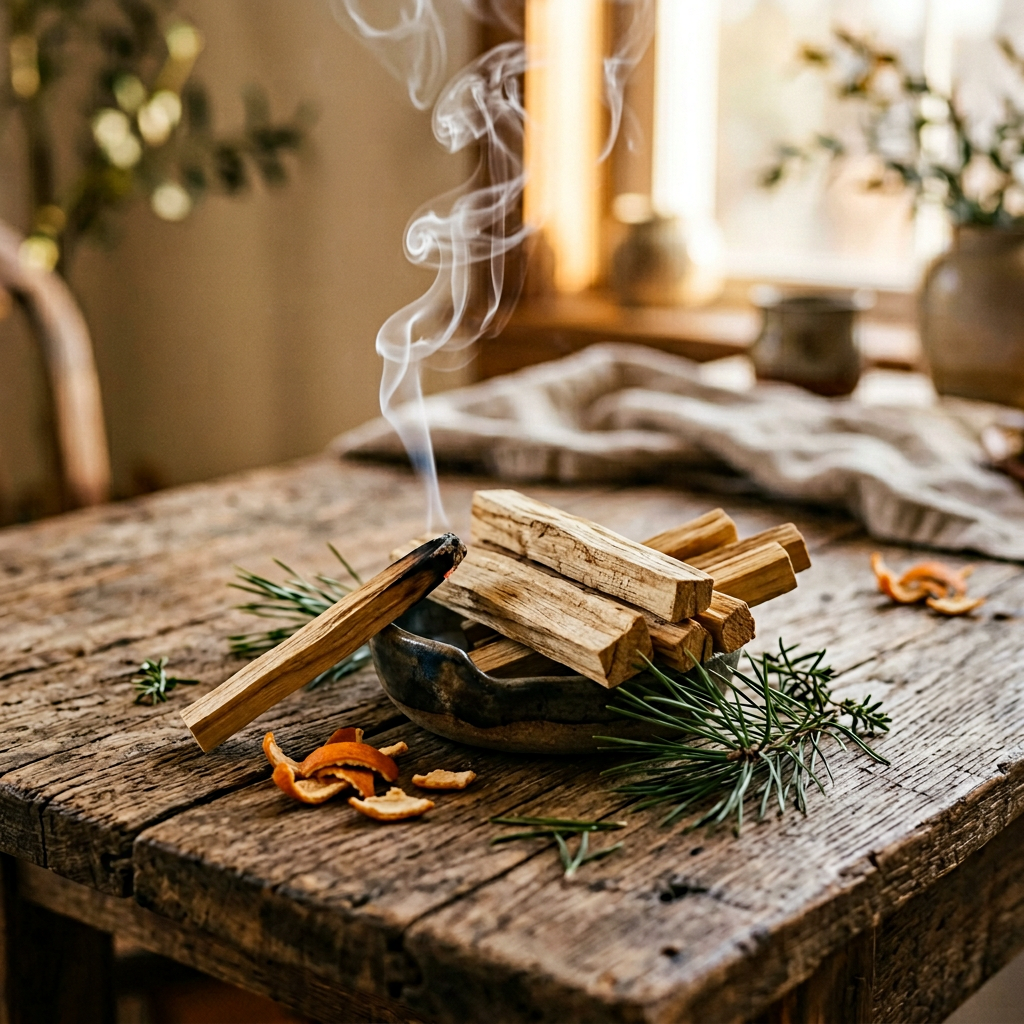
Good Palo Santo does not smell exactly the same to everyone.
Some people describe it as woody and citrusy. Others notice anise, licorice, creamy wood, sweet pine, natural incense, church incense, vanilla, amber, or even a nostalgic fireplace note.
What matters is whether the aroma feels natural. Real Palo Santo should smell like resinous wood smoke: warm, dry, slightly sweet, and natural.
But here is the thing: real Palo Santo is not always good aromatic Palo Santo.
Good Palo Santo should not smell like perfume, soap, air freshener, damp wood, chemicals, sour smoke, or a regular charred stick. If it does, the problem may not be whether the wood is fake. The real issue may be whether the aroma was properly developed in the first place.
A Palo Santo stick can be real and still not smell good
A stick can come from authentic Bursera graveolens and still fail the smell test.
But why?
Because Palo Santo is not judged only by its species. It is judged by what the wood is able to release when used.
Think of it this way: Palo Santo gets its characteristic scent from natural oils and resins that build up inside the wood over time. When a tree dies naturally and remains in the dry forest, the wood continues to change for years. During that resting period, the aroma becomes richer, deeper, and more concentrated. If the wood is collected too soon, it may still be genuine Palo Santo, but it often smells weak, plain, or surprisingly similar to ordinary firewood when burned.
Another common issue is the part of the wood being used. The outer layers of the tree tend to contain much less aromatic resin than the inner heartwood. That means a stick can look beautiful—light-colored, smooth, clean, and perfectly shaped—yet still produce very little fragrance. Some of the most visually attractive sticks on the market are actually the least aromatic because they come from wood that simply does not hold much resin.
This is why appearance can be misleading. A stick may look perfect and still deliver a disappointing experience, while a more irregular piece may release a much richer scent. What matters most is not how pretty the wood looks, but how much aromatic character it carries inside.
And that raises the question: if authentic Palo Santo can smell so different from one stick to another, what is actually creating that distinctive aroma in the first place? To answer that, we need to look at the natural compounds inside the wood that make Palo Santo smell the way it does.

Why does Palo Santo smell so good?
Palo Santo smells good because its aroma comes from the natural chemistry of the wood itself. The main idea is simple: Palo Santo is a resinous wood.
Inside Bursera graveolens, there are natural oils, resins, and aromatic compounds that give the wood its warm, sweet, smoky, and sometimes citrus-like smell. One of the most important compounds associated with Palo Santo is limonene. That is one reason some people notice a soft citrus edge, like lemon peel or orange rind. But citrus is not the whole story, and not everyone will notice it clearly.
Palo Santo also contains other aromatic compounds, including alpha-terpineol and related terpenes. These can contribute fresh, woody, herbal, creamy, balsamic, incense-like, or slightly sweet notes. So when one person describes Palo Santo as citrusy and another describes it as anise-like, creamy, smoky, or similar to incense, they are not necessarily smelling different things. They are noticing different sides of the same resinous wood.
But aroma is not only about what is inside the wood. It is also about how the wood releases that aroma when it burns. And this is where natural marks become important.
Natural Marks Are Not a Defect

Some Palo Santo sticks have small holes, darker lines, rough textures, or irregular marks. Many buyers see those marks and immediately think the wood is damaged.
But Palo Santo is not furniture. It is aromatic wood.
A perfect-looking stick can be completely authentic and still smell weak when burned if it doesn’t have enough resin, or if the wood doesn’t let heat and air move through it in a way that helps release its aroma.
When Bursera graveolens wood falls naturally and stays in the dry forest, insects, termites, larvae, dryness, and time can slowly change the structure of the wood. They do not add fragrance. They do not create the Palo Santo smell. What they may do is eat through softer wood fibers and leave tiny natural channels inside the stick.
These channels can act as small airways, allowing heat and oxygen to move through the wood more easily when it is lit. In simple terms: the resin is the aroma, but the natural channels may help the resin come out.
That is why a Palo Santo stick with natural marks can sometimes perform better than a perfect-looking stick. Not because holes are beautiful. Not because every insect mark is good. But because some naturally marked pieces may have been changed by the forest in a way that helps them release a warmer, sweeter, more resinous smoke.
The difference is balance. A good naturally marked stick should still feel firm, dry, aromatic, and resinous. The marks should not replace quality; they should support it. If the wood is fragile, powdery, humid, hollow, odorless, or burns too fast without resinous smoke, it is not premium Palo Santo. It is over-degraded wood.
Why Palo Santo Wood Origin Matters
Palo Santo origin matters because the aroma does not begin in the final product. It begins in the wood.
From the forest comes the aromatic base of Palo Santo: sometimes sweeter, sometimes drier, sometimes more resinous, more citrus-like, softer, smokier, or more intense. That base is shaped by the species, the dryness of the forest, the soil, the age of the wood, the amount of resin inside the heartwood, the natural resting process, and the microconditions surrounding the tree after it falls.
hese differences do not make one Palo Santo automatically better than another. They simply express different sides of the same resinous wood. This is why origin matters in the first place: it helps explain the natural personality of the Palo Santo itself.
The wood itself may already lean toward a certain aromatic profile. A softer, sweeter Palo Santo base naturally feels more comforting. A brighter, drier, more resinous base naturally feels more clarifying. A deeper woody base naturally feels more grounded. A warmer balsamic base naturally feels slower and more meditative.
The base can also be paired with other botanicals that emphasize one side of the Palo Santo instead of covering it. A warm botanical can bring forward the comforting side of the wood. A floral botanical, like Jasmine, can soften the smoke for decompression. A deeper wood, such as Sandalwood or rare Vietnamese Agarwood, can make the profile feel more grounded and intentional for focused work. A dense resin, like Black Copal or Myrrh, can intensify the balsamic, slow, and ceremonial side of the aroma.

How to Choose Better Palo Santo
In natural aromatic materials, character often comes from what the material has lived through.
That does not mean every mark, hole, dark line, or irregular texture is good. It means natural marks should not be rejected automatically. The real question is whether the wood still feels firm, dry, aromatic, and resinous.
Before buying Palo Santo, look for simple signals.
The stick should smell natural before burning. It does not need to be extremely strong, but it should have some woody, resinous, dry, warm, or slightly sweet character. Avoid Palo Santo that smells like perfume, soap, air freshener, humidity, chemicals, sour smoke, or nothing at all.
The wood should feel firm, not powdery, damp, rotten, hollow, or overly fragile. Small holes or natural marks are not automatically a defect, but the stick should still feel like solid aromatic wood.
Also, look for Bursera graveolens, clear origin, and responsible sourcing from naturally fallen or legally harvested wood. Be cautious with vague labels like “Palo Santo scent,” “Palo Santo fragrance,” or “extra strong aroma” if the product does not explain the wood itself.
After buying Palo Santo, the real test is the smoke.
Light the tip briefly, let the flame catch, then blow it out. Do not judge Palo Santo while the flame is actively burning, because at that moment you are mostly smelling burning wood fibers. Judge it after the flame is out and the smoke begins to rise.
Good Palo Santo smoke should feel warm, dry, resinous, natural, and alive. It may be soft or intense, sweet or smoky, citrus-like or balsamic, but it should still feel connected to real wood.
Smoke that smells like ordinary burnt wood, with no resinous depth, may point to a piece that is low in resin. A perfumed or overly uniform aroma can suggest added fragrance. Sour, damp, dirty, or harsh notes may come from poor storage or weak wood quality. And if the stick burns too fast or feels hollow, the wood may be over-degraded.
Better Palo Santo is not always the prettiest stick. It is the stick that still carries natural aromatic character before burning, releases resinous smoke when used correctly, and creates the kind of atmosphere you wanted in the first place.
